
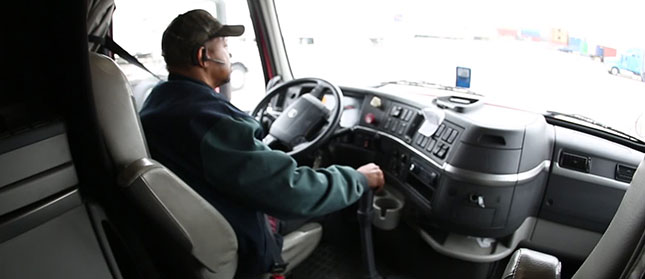
In the wake of yesterday’s accident and closure of the Toronto-bound Burlington Skyway, Ontario Trucking Association (OTA) is providing the public the latest information and safety data regarding the use of drugs and alcohol among commercial drivers.
It has become an industry standard over the last 20 years for companies to take proactive steps to ensure drivers are fit for duty, and not operating under the influence of alcohol or other drugs.
Operators of large commercial vehicles are much less likely to be impaired by alcohol or drugs than all other motorists and alcohol is very rarely a factor in North American driver out-of-service rates.
Regardless, OTA says yesterday’s event on the Burlington Skyway was an unfortunate occurrence and the trucking community is thankful the outcome was not worse.
“We want to ensure the motoring public that the actions this individual is accused of in no way reflect the professionalism of the hundreds of thousands men and women who operate their trucks in a safe and courteous manner every day,” says Stephen Laskowski, Senior VP, Ontario Trucking Association. “The fact that truck drivers are involved in zero per cent of fatal collisions where alcohol or drugs is a factor speaks volumes to the professionalism of Ontario’s truck drivers and the companies that employ them.”
FACTS & STATISTICS
Ontario Road Safety Annual Report, 2011 Data Regarding Drug and Alcohol Use Involving Commercial Drivers:
- Alcohol was involved in zero percent of all fatal collisions involving heavy trucks.
- According to the most recent Ontario Road Safety Annual Report (ORSAR 2011), Ontario’s drinking and driving rate was 0.12 per 10,000 licensed drivers (all classes of licences), the lowest fatality rate compared to, for example, every US State.
- According to ORSAR, large truck drivers are also less likely to be impaired by alcohol or drugs than all other drivers.
Recent US Data Confirms Low Alcohol and Drug Use Among Commercial Drivers:
- In only 0.23 percent of unannounced inspections in 2013, a commercial driver licence holder (CDL) was immediately placed out-of-service and cited for violating federal regulations governing alcohol consumption.
- In only 0.13 percent of unannounced inspections, a CDL holder was placed immediately out-of-service and cited for violating federal regulations governing controlled substances.
- In addition to random testing, truck and bus companies are further required to perform drug and alcohol testing on new hires, drivers involved in significant crashes, and whenever a supervisor suspects a driver of using drugs or alcohol while at work.
Canadian Commercial Drivers: Drug & Alcohol Testing Requirements for Drivers Operating into the United States:
The Federal Motor Carrier Safety Administration (FMCSA), along with the Department of Transportation (DOT), requires that all persons, regardless of nationality, subject to the commercial driver’s licence (CDL) requirements and their employers follow alcohol and drug testing rules. These rules include procedures for testing, frequency of tests, and substances tested for. These rules have been in place since 1995.
Canadian Commercial Drivers: Drug & Alcohol Testing Requirements if Operating Exclusively Within Canada:
If a commercial driver never operates in the United States, Canadian employers of commercial drivers are legally permitted to develop a policy that would allow for pre-employment and random alcohol and drug testing for commercial bus operators and truck drivers, provided employees who are drug dependent are accommodated. In Canada, a 2004 court decision and 2009 Human Rights Tribunal guidance document have provided employers with the guidelines to put these programs in place.
Skyway Commercial Traffic Stats:
- On an average day in Year 2013, the Burlington Skyway carried 9,200 commercial vehicles in the Niagara to Toronto direction of travel with cargo valued at $185 million.
- On average, each commercial vehicle heading to Toronto from Niagara Region crossing on the Burlington Skyway carries goods valued at $20,100 per commercial vehicle.
- In the reverse direction, although hourly distribution varies, the commercial vehicle and total traffic volumes remain balanced with the same daily volumes, the value of goods is higher in the Toronto to Niagara travel direction by 16% with $215 million per day.
- Thus, in total, the two-way Year 2013 commercial vehicle volume on the QEW Burlington Skyway was 18,400 with a combined cargo value of $400 million per average day.