
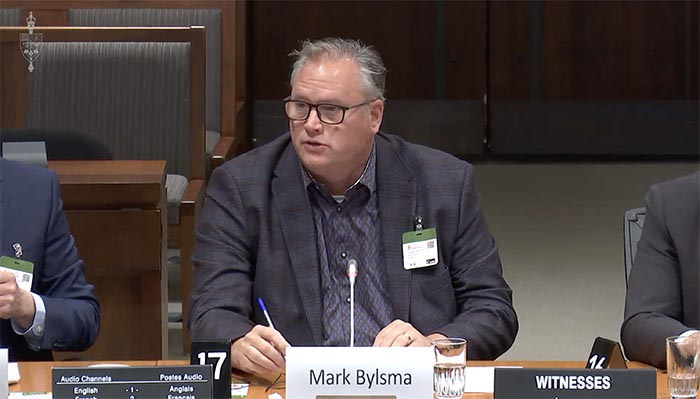
As the federal Transport Infrastructure and Communities Committee (TRAN) convened hearings on the Driver Inc crisis in trucking, the Ontario Trucking Association and several member carriers sent a clear message to Ottawa that it must keep its commitments to combat the rampant scheme and work with the Government of Ontario to end lawlessness in trucking and help it improve highway safety.
“It’s important we acknowledge two major milestones at this committee, which has helped in the fight against Driver Inc – the lifting of T4A moratorium by CRA and commitments made by ESDC for compliance blitzes and sustained funding,” said OTA chair Mark Bylsma. “These actions have given the responsible segment of the industry a glimmer of hope in these challenging times, but it’s critical that Ottawa continues to follow through and work with the province of Ontario, where there is a lot more work that needs to be done.”
OTA was represented by Bylsma, OTA Senior VP, Policy, Geoff Wood and several carrier leaders. They raised ongoing issues associated with the enforcement of Driver Inc in Ontario, as well as the many problems in the province associated with the scheme and general lawlessness like tax avoidance and labour and immigration abuse; degrading truck and highway safety; licensing fraud; insurance loopholes; WSIB infractions, stolen vehicle rings, illegal truck parking and land use; organized crime and extortion, as well as the lack of regular inspections and carrier safety oversight.
“It was a privilege to join OTA members this week to address the Committee. We are encouraged with actions already underway nationally and knowing the Committee is taking the issues seriously and seems prepared to consider many of our recommendations,” says Wood. “Provincially, we eventually hope to see the same level of interest and action to address this crisis from the Government of Ontario. Unfortunately, opponents of OTA’s position against Driver Inc are actively lobbying the province and have publicly garnered support from provincial leaders.
“We are hoping the federal committee continues to shine light on the crisis that is destroying the trucking industry and putting road users at risk and that governments at all levels put equal effort to ending Driver Inc and increase enforcement on this growing problem taking over the sector in Ontario.”
Additional OTA Member comments:
“I am here today as an operator living with real world consequences of Driver Inc., which is not self-employment, it is the misclassification of employees as independent contractors in order to avoid payroll taxes. What is occurring is payroll fraud that has become normalized. Driver Inc did not necessarily emerge because most carriers are inherently malicious; it emerged because trucking operates on extremely thin margins, enforcement is fragmented, and price, not compliance, has become the dominant factor into shipper decisions. When enforcement is inconsistent, the market rewards the lowest price regardless of how it is achieved. Noncompliance becomes a competitive advantage where compliant companies are punished while non-compliant ones are rewarded.
- Michael Ludwig, Operations Manager, Ludwig Transport Ltd
“The industry and my family that runs a compliant business appreciate the commitment of the federal government to control the lawlessness in trucking; however, I think we’ve got a long way to go. About six out of 10 drivers who apply at our place want to be illegitimate contractors. Simply put, there’s not enough being done to protect the future of family businesses that are in jeopardy. Our industry has unfortunately attracted some of the lowest calibre participants in recent years, whose lack of ethics and respect for law and order is jeopardizing family businesses that took decades of care investment and credibility to build. Many of these fleets we compete with do not share our vision of safety; yet all of us and their families share the road with them.”
- Jeff Hall, President, J. & R. Hall Transport Inc.
“My company has operated in this industry for over 40 years, with a strong focus on safety and compliance. I’m here because what is happening in the trucking industry is no longer just a business problem; it has become a public safety issue. This crisis has outgrown provincial tools alone and now requires increased federal collaboration. Provincially, (in Ontario), I am increasingly concerned about driver licensing and training. People are entering the industry with credentials that do not match the actual competency. It is common to hear that licenses can be obtained through informal networks, set up through improper training and testing. This points to a broken system. Secondly, driver misclassification has adapted and evolved … Many drivers are still actively seeking arrangements that avoid normal employment obligations as some carriers continue to structure work in ways that disguise the true relationship.”
- Vince Tarantini, President, Carmen Transportation Solutions Ltd.